Theme 2: Women and youth access to land
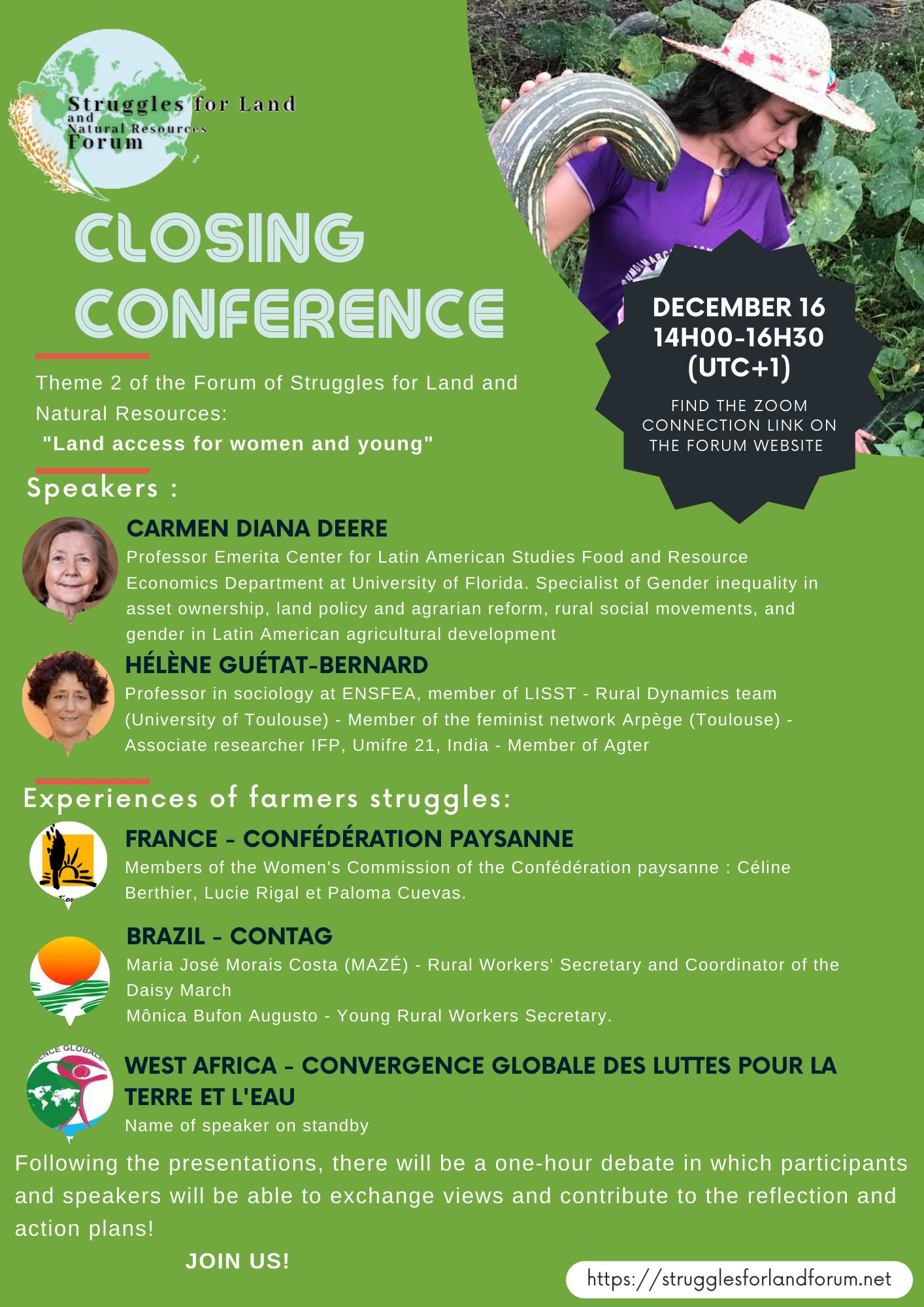
The closing conference on this theme took place on 16 December. You will soon find on this page a summary of this discussion and proposals for further work on this theme.
To watch the closing conference :
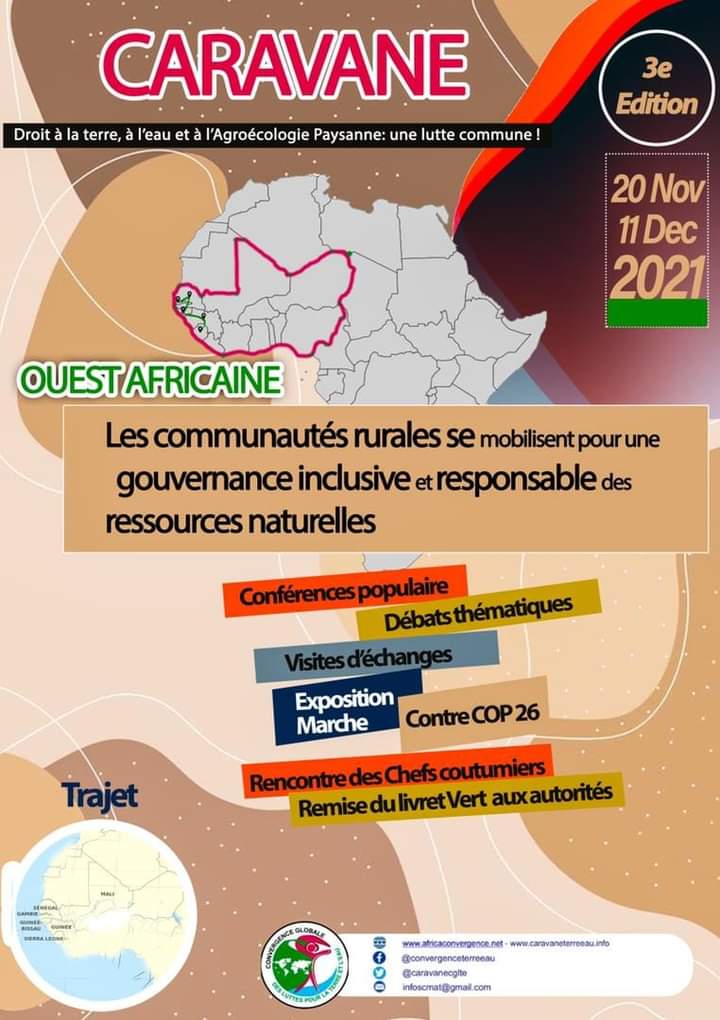
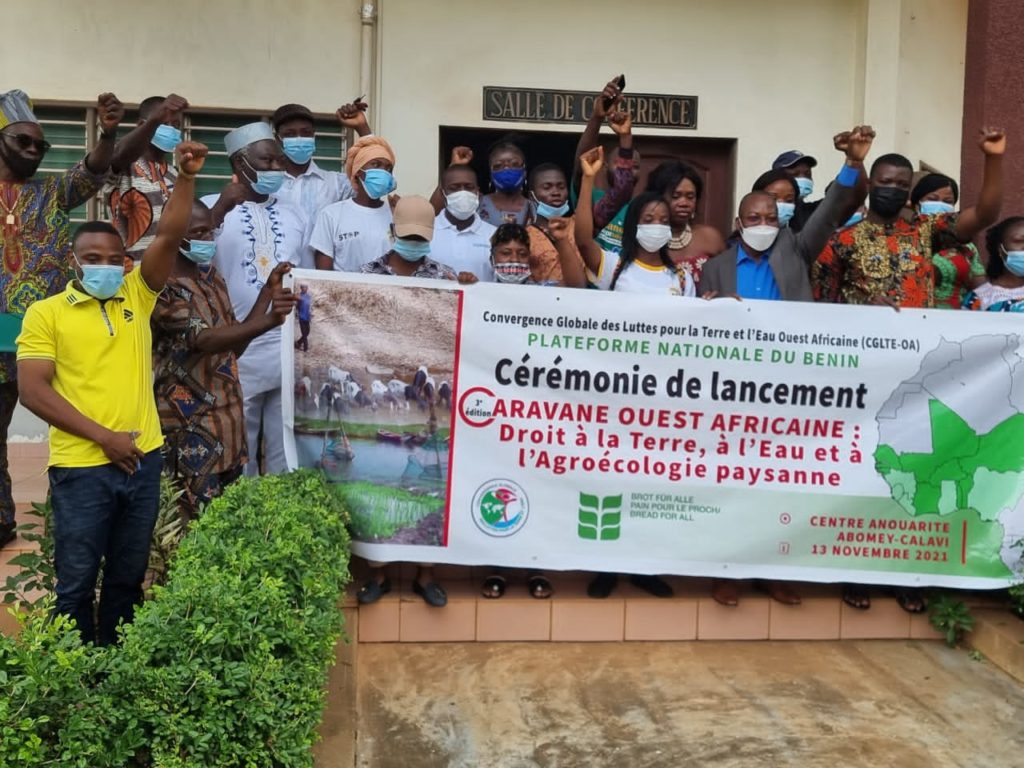
Main co-organiser: Convergence of Struggles for Land and Natural Resources - West Africa on the occasion of the launch of the third West African Caravan on the Right to Land, Water and Peasant Agroecology.
In the meantime, you can continue to share your experiences of struggles and your thoughts on this issue on the "Online discussions" page.
To be kept informed of upcoming events through the forum newsletter and to participate in the discussions, please register by following the link on the right.
Presentation of the theme
Women's access to land and natural resources is a key international issue. Too often, women's rights to land and natural resources are minimised or denied in favour of men, even though they make up the bulk of the peasant workforce and play a key role in agricultural production and natural resource management. This is the combined result of two major factors:
- customs reinforced by the misinterpretation of religion,
- land policies and laws that do not sufficiently recognise the place of women.
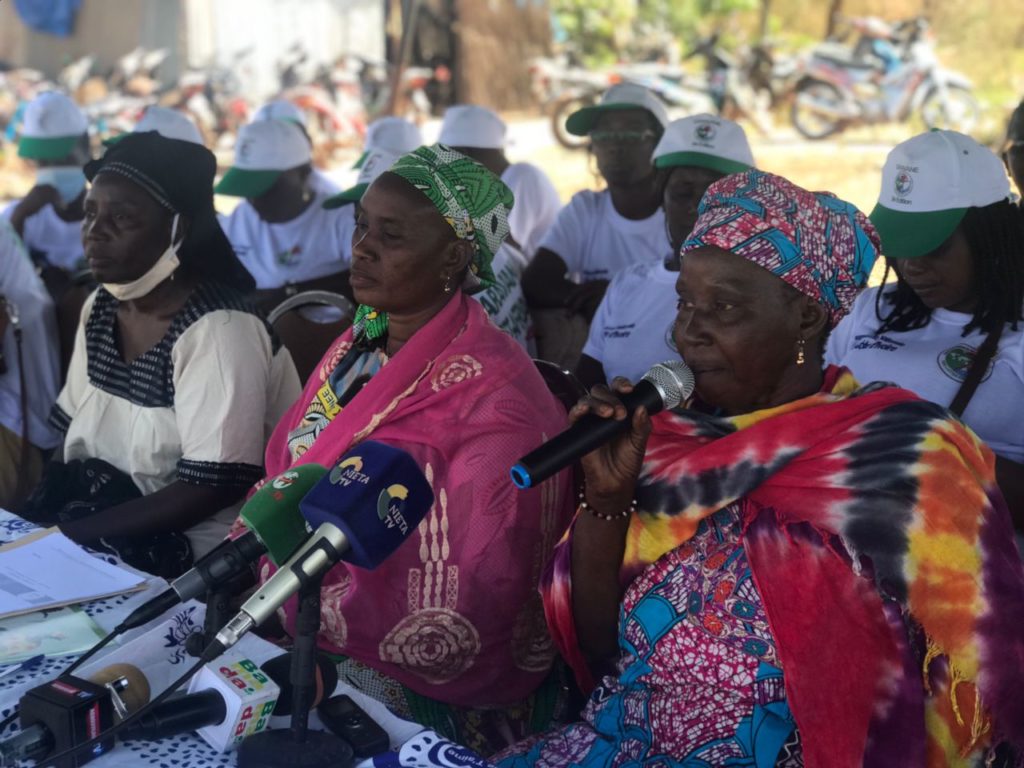
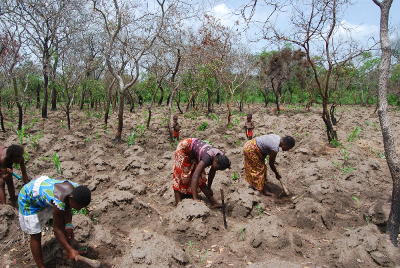

Women peasants are therefore doubly penalised, on the one hand because as peasants they are subject to the same pressure as men in terms of land grabbing, particularly on the commons which are often their main source of resources, and on the other hand because within the communities they are discriminated against by patriarchal traditions.
Young people are also affected by these patriarchal customs, which also make it difficult for them to access land and become empowered, with the result that they tend to flee the rural world and abandon agriculture, weakening communities and leaving them vulnerable to external pressures, when they could have an important role to play in strengthening them and ensuring the future of peasant agriculture. The difference with women is that young people are destined to become senior citizens, so this discrimination is temporary, unlike that affecting women.
This discussion will be based on the experience developed by the UACCDDDD (Union of Associations and Coordination of Associations for the Development of the Rights of the Poor), a member of the Malian Convergence Against Land Grabbing (CMAT) in Mali.
Purpose of this discussion
This approach was developed in the specific context of West Africa, and does not claim to have universal value. Struggles must be adapted to local and national contexts, and therefore the forms of mobilisation will necessarily be different in other regions. The objective of this debate will be to compare the experiences of women's struggles around the world with that of the UACCDD and to reflect on possible common actions between various organisations and regions mobilised around this struggle, and on the international advocacy to be strengthened.
Theme 2: Timeline
- 23 November: Launch videoconference
- 24 November to 16 December: online exchanges and discussions.
- 16 December : Closing of the theme with the presentation of 3 emblematic struggles presented by women farmers from all over the world
- January 2021: Videos of the videoconferences and summary documents available on the website
Please excuse me, I hadn’t finished my comment. So, I was saying that investigators aren’t trying to determine whether women own plots of land or not. As a result, women are regularly evicted from areas where they are only temporarily allowed to grow subsistence crops. So their access to land isn’t secure. Sometimes their crops are uprooted or burned. Since they are uneducated, they have no other alternatives. They are also not trained in activism and live in fear… Read more »
Hello Yale, and thank you for sharing this. We will be sure to follow up with the forum participants to share the results with you. A summary will be prepared in the coming weeks and shared on the website and via a newsletter sent to all participants. We will be sure to include your post in that summary.
Good evening, everyone. I would like to commend you on the work you have done. Above all, thank you for taking an interest in the lives of rural women by organizing this forum on women’s access to land. In my village of Tiegba in Côte d’Ivoire, the majority of women are poor. Their children are out of school, and the girls turn to prostitution to support themselves. Current laws have not sufficiently taken into account the unique circumstances of women. Women are not supported by the… Read more »
Hello. Thank you for the video conference and for the contributions here. Thank you, Paolo Groppo, for connecting us to the 2016 FMAT and to our collective journey of reflection and struggle. I agree with the points raised and would like to add: 1) these inequalities in women’s access to land rights are intertwined with other inequalities and with a certain structure of how we inhabit the world and relate to one another—a topic that is also important to discuss. Feminist movements and critical thought have challenged this. 2) A sharing of field experience and hypotheses/questions. During an agrarian assessment… Read more »
I was waiting for new contributions before speaking up, but I still only see three, with just 10 days left before the end of the online discussion, and unfortunately none from West African organizations. The first videoconference, which was fortunately enriched by significant participation from CONTAG given the inability of the Convergence of Struggles in West Africa to connect, leads me to the following comments and questions: 1/ Women’s and young people’s access to land varies greatly depending on social and ethnic groups, even though national laws are in… Read more »
Recalling the work of the 2016 WFAL thematic group, I believe it would be appropriate for the various organizations to take stock of the actions they have taken to advance the list of proposals outlined in the group’s final document. = Recalling the work of the 2016 WFAL thematic group, I think it would be appropriate for the various organizations to take stock of the actions they have taken to advance the list of proposals outlined in the group’s final document = Recalling the work of the 2016 WFAL thematic group, I think it would be appropriate for the various… Read more »
CONTAG held Regional Agrarian Reform Meetings, and this was one of the songs we shared
Spanish – French – English – Portuguese Land Inheritance I found the presentation by Fanny, a French farmer, very interesting. There is already ample evidence from national and/or regional studies confirming that, under both statutory and customary legal systems, most women—regardless of their marital status—cannot inherit land in their own name. A problem that affects not only countries in the Global South, but also, as Fanny confirms, those in the Global North. I wanted to recall how this issue was a hotly debated topic during the 2016 FMAT in Valencia. The specific working group dedicated to… Read more »